Accelerate Change with AI: Build Better Work Habits
Change Management, AI Adoption, Digital Transformation
Using AI as an Adoption Tool: How to Accelerate Change and Build Better Habits
How AI can strengthen human-led change, improve adoption of CRM, ERP and AI initiatives, and help employees build new habits in the flow of work.
1. Introduction: AI is not only the change—it can support the change
In many organizations, artificial intelligence is framed as the change—a new technology to roll out, govern, and de-risk. That view is only half the story. AI can also be a powerful adoption tool that helps people understand change, learn new processes, receive real-time support, ask questions safely, practice new behaviors, and give feedback as they go.
At Change Architects, we see a clear distinction between adopting AI and using AI to improve adoption. The first is about implementing AI as a new capability. The second is about weaving AI into your change strategy so employees are never alone as they navigate CRM upgrades, ERP rollouts, AI deployments, or process transformations. When used thoughtfully, AI becomes a practical, human-centered companion to change—not a replacement for leadership, managers, or sound strategy.
2. Why traditional adoption approaches often fall short
Most organizations still rely on a familiar playbook: a launch announcement, a slide deck, some training sessions, a FAQ document, and a reminder or two. These activities are important, but they rarely match the reality of how people learn and work. Adoption stalls because:
Communication is one-size-fits-all, even though roles, locations, and levels of readiness differ widely.
Training is event-based rather than continuous, so people forget what they learned when they finally need it.
Support is hard to reach in the moment of need, leading to workarounds and frustration instead of new habits.
Leaders and managers lack timely insight into where people are struggling, so interventions come too late.
The result is predictable: underused systems, inconsistent processes, and change fatigue. AI, used carefully, can help close these gaps by bringing personalized guidance, immediate answers, and real-time insight into the daily rhythm of work.
3. What it means to use AI as an adoption tool
Using AI as an adoption tool means designing AI around the human experience of change. Instead of asking, “How do we get people to use this AI?”, the question becomes, “How can AI make it easier for people to adopt this change?”
Concretely, this includes AI that:
Delivers personalized communications that explain what the change means for each role or team.
Curates role-based learning paths and micro-lessons based on tasks, systems, and skill gaps.
Powers chatbots and virtual assistants that answer “how do I…?” questions in plain language, 24/7.
Provides in-the-flow-of-work guidance directly inside CRM, ERP, HR, or collaboration tools.
Helps managers with coaching prompts and talking points tailored to their team’s adoption patterns.
Importantly, this is not about replacing human connection. AI should strengthen human leadership, not stand in for it. The best adoption tools make it easier for leaders, managers, and change teams to listen, respond, and support people at scale.
4. Seven practical ways AI can improve adoption
Personalized communications. AI can segment audiences by role, location, tenure, or past engagement, then generate tailored messages that answer “what does this mean for me?” For example, a frontline operations leader might receive concise, scenario-based updates, while a finance leader gets deeper detail on controls and reporting changes.
Role-based learning. Instead of a single generic training, AI can recommend learning modules based on the systems and processes each person uses. A sales manager might see micro-lessons on pipeline hygiene in the new CRM, while an HR business partner receives guidance on updated talent workflows in the ERP.
AI-powered chatbots and virtual assistants. Embedded assistants can answer questions, walk users through tasks, surface relevant FAQs, and escalate complex issues to human support. They reduce the friction of “I don’t know where to look” and capture the themes of questions to inform future improvements.
In-the-flow-of-work guidance. AI can deliver step-by-step prompts, tooltips, and checklists exactly when someone is performing a new process—logging a customer interaction, approving a purchase order, or configuring an AI model. This moves learning from the classroom into the real world of work.
Manager coaching support. AI can generate manager talking points, one-on-one discussion guides, and team meeting agendas based on current adoption data. Managers remain the face of change, but they are no longer left to craft messages alone or guess where to focus their time.
Knowledge retrieval and FAQs. AI can search across policy documents, training materials, and help content to answer “how do I…?” questions in natural language. This reduces the time employees spend hunting for the right slide or PDF and keeps guidance consistent across channels.
Sentiment, feedback, and adoption analytics. AI can analyze survey responses, open-text comments, chatbot logs, and usage data to identify patterns: where confusion is high, where adoption is lagging, and where behaviors are taking hold. This gives change teams an earlier, clearer view of reality.
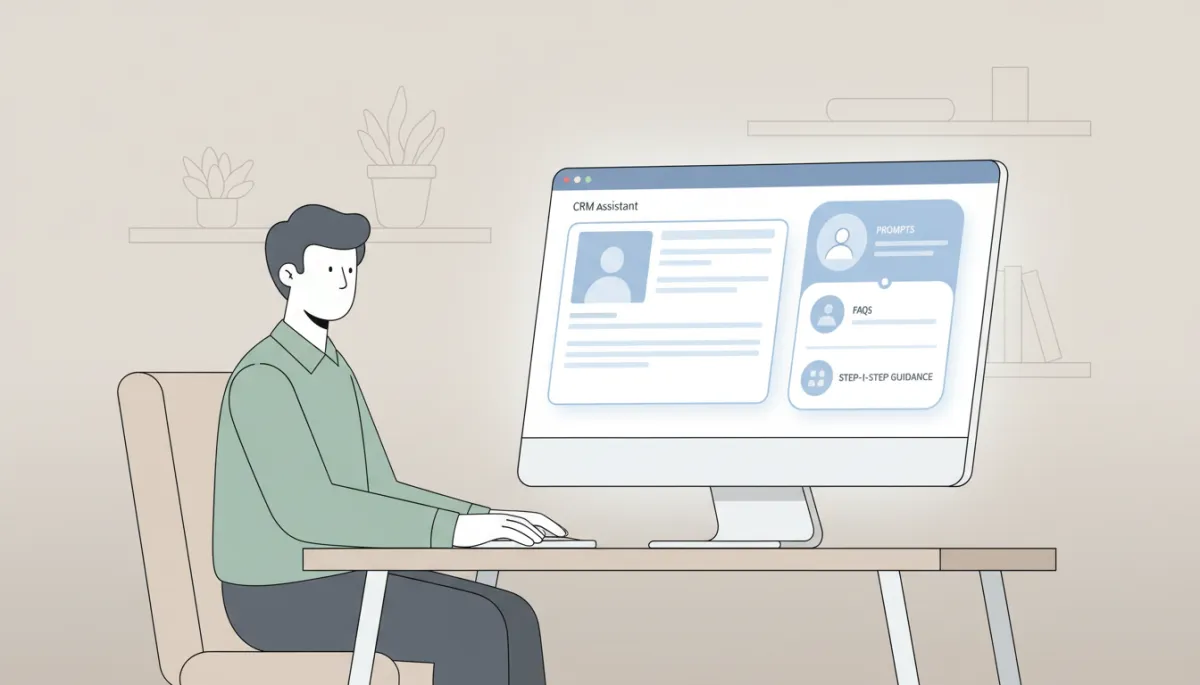
Embedded AI assistance helps employees practice new behaviors directly inside core systems.
5. Examples across CRM, ERP, AI, and process transformation
Across major platforms and transformations, AI can be woven into the adoption journey in practical ways:
AI assistants inside CRM. A sales rep opens the CRM and sees an AI assistant suggesting the next best step, reminding them of required fields, and offering a short explainer on a new stage definition. The assistant can answer, “How should I log a renewal opportunity under the new process?” in context, without leaving the screen.
Chatbots answering ERP questions. In a new ERP, employees can ask, “How do I submit a capital request?” or “What changed in the approval workflow?” and receive clear, step-by-step guidance pulled from the latest process documentation and policies, plus links to short learning videos where needed.
Personalized learning recommendations. As people begin using a new AI-powered analytics tool, the system notices which features they use and which they avoid. It recommends targeted micro-lessons—such as “Try building a simple dashboard” or “Practice writing a prompt to filter this data”—to build confidence gradually.
AI-generated manager talking points. Before a town hall on process transformation, leaders receive AI-generated talking points tailored to their business unit, highlighting relevant benefits, known concerns, and examples from their own teams. Managers can refine these messages, but they no longer start from a blank page.
Analysis of employee questions. The change team reviews AI-generated summaries of chatbot conversations and helpdesk tickets. They see that many questions cluster around reporting changes and data access. Communications and training are adjusted quickly to address those specific pain points.
Automated follow-up messages. After go-live, AI triggers short, targeted follow-ups based on behavior. For example, someone who has not used a key feature receives a brief tip and link to a two-minute walkthrough, while a power user is invited to share best practices or join a champion network.
6. How AI can support employees in the flow of work
Real adoption happens in the flow of work, not in the training room. AI makes it easier to embed support directly into the tools and moments where people need it most. This can look like:
Contextual prompts that appear when someone performs a task for the first time, offering a quick explanation or a short video walkthrough.
Inline FAQs that surface when a user hovers over a new field, status, or button, answering “what is this?” without leaving the screen.
Micro-surveys and feedback prompts that ask, “Was this step clear?” or “What made this task difficult?” at the moment of completion, not weeks later.
For employees, this reduces the cognitive load of remembering new steps and gives them a private, low-risk way to ask questions. For change leaders, it turns everyday work into a rich source of insight about where to simplify, clarify, or reinforce.
7. How leaders can use AI-generated insights to improve the change strategy
AI does more than deliver support; it also helps leaders see the story of adoption as it unfolds. By analyzing usage data, sentiment, questions, and feedback, AI can highlight:
Which teams are adopting quickly and which are lagging, so support can be targeted rather than generic.
Common questions and misconceptions, so communications and training can be updated in days, not months.
Sentiment trends across regions or functions, helping leaders understand where trust, clarity, or psychological safety may be at risk.
For business, HR, learning, technology, and operations leaders, these insights can inform decisions about pacing, resource allocation, and communication focus. The key is to use AI-generated analytics as a starting point for human conversations, not as the sole answer. Leaders still need to listen, ask questions, and be visible in the change.
8. Risks, governance, and responsible use
Like any powerful tool, AI carries risks when used for adoption. Being explicit about these risks—and designing governance around them—is essential to building trust:
Incorrect or outdated information. AI-generated answers can be wrong or misaligned with current policy. Guardrails, curated knowledge sources, and human review are critical, especially for high-risk topics such as pay, compliance, or data privacy.
Privacy and data concerns. Sentiment analysis and usage tracking must respect privacy expectations, legal requirements, and organizational values. Be transparent about what is collected, how it is used, and how individual identities are protected.
Overreliance on automation. If leaders or employees assume “the bot will handle it,” human connection and psychological safety can erode. AI should never be the only channel for raising concerns or seeking support about change.
Governance gaps. Without clear ownership, AI assistants and content can drift, become inconsistent, or conflict with other channels. Change, HR, IT, and communications need a shared governance model for AI-enabled adoption tools.
Lack of human support. If AI is positioned as a replacement for human help, employees may feel dismissed or unheard—especially when dealing with sensitive issues. Make it easy to escalate from AI to a person who can listen and respond empathetically.
Disconnected tools. Multiple bots or assistants that do not share context can confuse employees. Integrated design and a clear entry point for help reduce friction and build confidence.
Responsible use means being honest about limitations, inviting feedback, and keeping humans—especially leaders and managers—at the center of your change narrative.
9. The AI-Enabled Adoption Loop: A practical framework for getting started
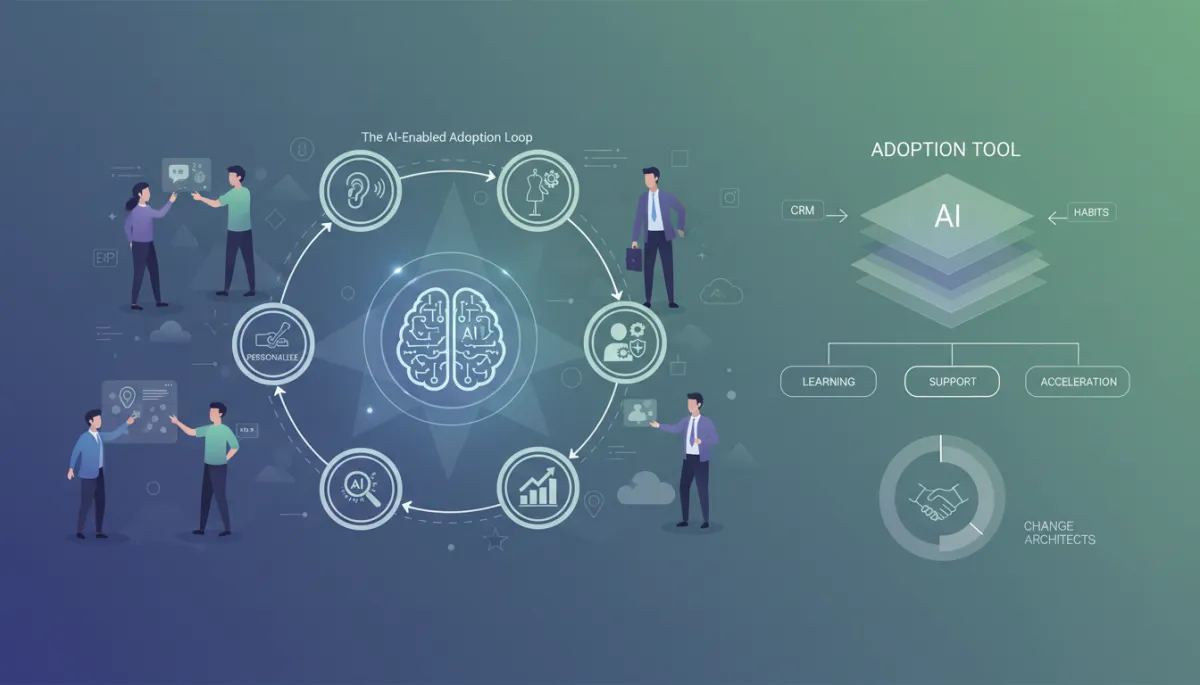
To move from isolated experiments to a coherent approach, Change Architects uses a simple, practical framework: The AI-Enabled Adoption Loop. It has five connected elements—Listen, Personalize, Support, Measure, Reinforce—that can be applied to any CRM, ERP, AI, or process transformation.
Listen
Use AI to listen at scale. Analyze employee questions, chatbot interactions, survey comments, and adoption data to understand what people are asking, where they are stuck, and how they feel about the change. Combine these insights with qualitative conversations so you hear both the signal and the story behind it.
Personalize
Turn those insights into targeted communication and learning. Use AI to generate role-based messages, tailored FAQs, and curated learning paths that reflect what different groups need most. Personalization should reduce noise, not add to it—fewer, more relevant touchpoints instead of more generic broadcasts.
Support
Embed AI-powered support in the flow of work. This includes chatbots, guided workflows, and contextual tips inside core systems. Make it easy for employees to ask questions, practice new behaviors, and access just-in-time guidance without leaving their daily tools. Ensure there is always a clear path from AI support to human support when needed.
Measure
Use AI to measure adoption and experience continuously. Move beyond simple logins to track behaviors that matter: data quality, process completion, cross-team collaboration, and use of key features. Pair quantitative adoption analytics with sentiment analysis and feedback themes to understand not just what people are doing, but how they are experiencing the change.
Reinforce
Finally, use AI to reinforce new habits after go-live. Automated follow-up messages, nudges, recognition of positive behaviors, and refreshed learning recommendations all help sustain change over time. Reinforcement should feel supportive, not punitive—reminding people of the “why” as well as the “how.”
Because the AI-Enabled Adoption Loop is cyclical, insights from Reinforce and Measure feed back into Listen and Personalize. Over time, your adoption approach becomes more responsive, more human-centered, and more effective with each iteration.
10. Conclusion and call to action
AI is reshaping how organizations work—but its greatest value for change may lie in how it supports people, not just what it automates. When you distinguish between adopting AI and using AI to improve adoption, you open up new possibilities for clearer communication, more inclusive learning, better support, and more responsive leadership.
For business, HR, learning, technology, and operations leaders, the opportunity is to treat AI as a partner in building better habits—one that strengthens, rather than replaces, human leadership, manager involvement, thoughtful change strategy, and genuine employee engagement. With the right governance and a practical framework like the AI-Enabled Adoption Loop, AI can help every transformation feel more guided, more supported, and more sustainable.
If you are planning or already navigating a CRM, ERP, AI, or process transformation and want to explore how AI can serve as an adoption tool—not just a new technology—Change Architects can help. Start an AI adoption conversation with Change Architects to design an approach that is strategic, credible, practical, and deeply human-centered.
SEO Title, Meta Description, URL, and FAQs
SEO Title (under 60 characters): Using AI as a Change Adoption Tool
Meta Description (150–160 characters): Learn how to use AI as a change adoption tool to personalize support, build new habits, and strengthen human-centered transformation in your organization.
Suggested URL Slug: using-ai-as-a-change-adoption-tool
Frequently Asked Questions
1. What is the difference between adopting AI and using AI for adoption?
Adopting AI means implementing AI as a new technology. Using AI for adoption means applying AI to improve how people understand, learn, and sustain any organizational change, including CRM, ERP, AI, or process transformations.
2. How can AI support employees without replacing human leaders?
AI can handle routine questions, provide in-the-moment guidance, and surface insights, while leaders and managers focus on context, empathy, decision-making, and relationship-building. AI should extend, not replace, human leadership.
3. What are practical first steps to implement AI as an adoption tool?
Start small: choose one change initiative, define a specific use case (such as an AI-powered FAQ or role-based learning recommendations), establish governance, and measure impact using the AI-Enabled Adoption Loop.
4. How do we manage risks like incorrect answers or privacy issues?
Limit AI to curated knowledge sources, use human review for sensitive topics, be transparent about data use, and create clear escalation paths to human support. Governance across HR, IT, legal, and change teams is essential.
5. How can Change Architects help with AI-enabled adoption?
Change Architects partners with organizations to design AI-enabled adoption strategies, select and shape use cases, establish governance, and apply the AI-Enabled Adoption Loop across CRM, ERP, AI, and process transformations.